Saturday, March 30, 2013


Mrs DallowayMrs Dalloway by Virginia Woolf
My rating: 5 of 5 stars

Of Life and Death, Verbs and Nouns

I expected this novel to be difficult. However, it wasn't difficult at all. It was an enormous pleasure.

I was struck by the preponderance of
  verbs

.

The novel might happen in the head of Clarissa Dalloway or the other characters, but they are observing activity and their thoughts reflect it.

It is more dynamic than passive or self-conscious or self-reflective.

It was less a stream of consciousness, than a consciousness of life as a stream or a number of streams, rolling and tumbling and flowing in the direction of some great expanse, the ocean, an ocean of possibilities, perhaps even a party.

The word "life" is a noun, but in my opinion, the Life we live is a bundle of verbs. Life is the vitality and vibrancy of the verbs we inject into it. Life is what you "do" during the course of your time on earth. All the large and little things you do.

Life is Eros, a life force, which can be juxtaposed in Freudian terms with Death (the absence of life) or Thanatos.

Perhaps Clarissa Dalloway represents the vitality of Eros, while her "double", Septimus, represents Thanatos.

Whatever, the two coexist in the novel and in each of us.

How our lives turn out depends on how we accommodate their coexistence.

We can let them fight or allow them to dance.

"A Dance to the Music of Time"

Ultimately, Virginia Woolf's novel felt to me like a dance, a progressive waltz, perhaps between Life and Death, Eros and Thanatos.

It seemed to be even more worthy of the description "A Dance to the Music of Time" than Anthony Powell's work.

Here is a description of the Poussin painting of that name from the first novel in the sequence, "A Question of Upbringing", part of which could apply to "Mrs Dalloway":

"These classical projections, and something from the fire, suddenly suggested Poussin's scene in which the Seasons, hand in hand and facing outward, tread in rhythm to the notes of the lyre that the winged and naked greybeard plays.

"The image of Time brought thoughts of mortality: of human beings, facing outward like the Seasons, moving hand in hand in intricate measure, stepping slowly, methodically sometimes a trifle awkwardly, in evolutions that take recognisable shape: or breaking into seemingly meaningless gyrations, while partners disappear only to reappear again, once more giving pattern to the spectacle: unable to control the melody, unable, perhaps, to control the steps of the dance."


description

I started to gyrate as I read on, then unable to control the melody, unable to control the steps of the dance, I grew dizzy, and slowly I started to remember something that happened a long, long time ago...


The Call of Duty

Each long table in the dining room seated 20 people, ten aside facing each other, as you'd expect, just like the year before, only now there would be some faces gone and some new faces expected, you wouldn’t really know who until everybody had returned from the end of term vacation and taken their position, some sitting in the same place, some moving to fill the gaps, some leaving a space to be filled by someone new.

There were a dozen or so at their usual table by the time Ian arrived for dinner, he looked up and down the table, until he saw six familiar faces, a hint of recognition on his face, his friends were all towards one end of the table, away from the front doors, although nobody occupied the two end seats, they had been left for latecomers.

To the left of his friends, a group of first year students were sitting in the middle of the table, not yet known or identified by names, so Ian pulled out a seat at the end of the table and prepared to sit down, gently lifting his chair so as not to make a sound and disturb the conversation that was in progress, chatter, chatter, talk, talk, this is what I did on my holidays, Keith had obtained work as a legal clerk, Ginny had spent the whole time at her parents’ beach house on the South Coast, Becky had returned to Switzerland and worked in a strawberry jam factory, making tiny woodchips that were supposed to replace the seeds that dissolved in the acidic process of making the jam.

An olive, almost dark, complexioned woman walked up and asked if she could sit on the chair opposite Ian, he nodded yes, not knowing who she was or whether she already knew his friends, she had not been in college last year, while everybody else reacted enthusiastically, yes, sure, of course, thanks for joining us, Judy, Becky said, have you met everybody here, this is Ian, she said, I’ve heard so much about this Ian, Judy replied with a smile, in her Eastern European accent, he couldn’t work out where it was from, though it was not as guttural as German, he stood and shook Judy’s hand, almost chivalrously, although there was no need for chivalry yet, at least, nothing to be chivalrous about, these days, apart of course from the presence of this charming woman, which was more than enough, but Ian was already smiling, he liked this new Judy.

She answered Ian’s many eager questions politely, until finally he had ascertained that she was Hungarian, and that her father was the Hungarian Ambassador, from Communist Hungary, as it was then, she was moving into college for her second last year while she worked on her honours thesis in French Literature and wanted to be closer to the French Department and away from the temptations of diplomatic parties and constant socializing, as if college life would be any less demanding, even though she loved that life, she was diligent in her studies, she wanted to be a writer, a publisher or a diplomat herself, and Ian had found all of this out while he deftly worked away at his roast lamb and three vegetables, it was a Sunday night before the first day of the new term, and there was always a roast of some sort.

Some of their friends finished their meals and left during the conversation, though Ian continually brought the chit chat back to Judy, as if they were the only ones present, you could tell he was infatuated already, well, Becky could, she was more alert to these things, her father was the Australian Ambassador to Switzerland, it wasn’t a big deal, Switzerland was only a small country anyway, it wasn’t even discussed amongst their friends, but they had nevertheless gravitated towards each other, informally forming a group of diplomatic children, Ian being the odd one out, the son of a banker, though his ambition was to be a diplomat, and if unsuccessful in that ambition, to at least get a few foreign affairs under his belt, he had a taste for the exotic, almost as if he was seeking a life raft upon which to escape from the routine life that awaited him in Australia in those days.

Judy was the first one of the remaining group to rise from the table, but as she did so, she reached into her handbag and took out four small envelopes, they contained invitations, each of them inscribed with someone’s name in neat blue fountain pen, though not the script that was familiar to Australians at the time, even her writing was exotic, she gave three to Ian’s remaining friends, and then, looking Ian in the eyes, handed him one, too, I would be delighted if you would come to my room for drinks on Tuesday night, any time between 8 and 11, Ian looked at the envelope and saw that it already bore his name, Ian Graye, he still has that envelope somewhere, with his other love letters and curios, Judy said, I knew I would meet you sooner or later, so I took the liberty of making out an invitation for you, what if you hadn’t liked me, he asked, well, in that case, I would have wasted an envelope and some writing paper, she said, not a great loss, but I didn’t think there was much chance of that.

No sooner were the envelopes circulated than Judy left to return to her room, Ian rising almost immediately afterwards, looking at his watch and saying, well, duty calls, Becky spotted the glint in his eye and laughed, you mean, Judy calls, and she laughed again, as if she had just read his fortune in a teacup.

The next two days, Ian didn’t see Judy or Becky or Keith or Virginia, because other friends saw him enter the dining room and asked him to join them, each time introducing him to first year students that they had just met, so Tuesday night came around quickly, although first he had to have some drinks in the Union Bar with some other students from his Political Science class, he had intended to finish up around 10pm and return to college for the last hour of the party, but it was 10:30 when he looked at his watch and realised he was going to be late, it was totally dark when he got outside, there was no moon and the stars were obscured by clouds, he walked quickly, anxiously, embarrassed, the crushed granite surface of the footpath crunching underfoot, his heart started to beat faster and a droplet of sweat formed on his temple, he was almost out of breath by the time he arrived at Judy’s door, giving the impression that he had hurried to be there, even though he was close to three hours late and had nearly, rudely, missed the party altogether, still as Judy was farewelling some of her other guests, she greeted Ian with a kiss on either cheek in the European fashion, and he wished that it had been his lips, I didn’t think you were going to attend my party, she said, half reproachful, half delighted that he had actually turned up, he said, there was no way I would have missed it, I’m sorry that another duty called, she poured him a glass of Bulls Blood, Egri Bikaver, and sat him on the chair next to her writing desk, by this time they were the only ones left in the room, and she sat on her bed, from this time on, she said, I expect to be your first duty, Ian placed his glass on the desk, having had only one sip, not that it was his first and only drink of the night, and he went and sat on the bed next to her and, perhaps too boldly, he passed his right hand under her black bob, and then their lips touched, for the first, but not the last, time.

A moment later, she pulled back, not by way of rebuff, by any means, and commanded him gently, but still firmly, tell me, what is the name of your most important duty now?

It is Judy, he said.

And there she was.


SOUNDTRACK:

Jimmy Smith - "Who's Afraid of Virginia Woolf"

http://www.youtube.com/watch?v=CG0r80...

Herbie Hancock - "Watermelon Man"

http://www.youtube.com/watch?v=p4ASTM...

Bill Lee [Composer] - "Mo' Better Blues"

http://www.youtube.com/watch?v=jJTKCm...

That's Denzel Washington lip-synching the trumpet in the Spike Lee film of the same name.

The band comprises trumpeter Terence Blanchard, Branford Marsalis on tenor and soprano, pianist Kenny Kirkland, bassist Robert Hurst, and drummer Jeff "Tain" Watts.

Di Ienno, Di Bella, Mori Trio - "Mo' Better Blues"

http://www.youtube.com/watch?v=_ahH2I...

View all my reviews


AM/PMAM/PM by Amelia Gray
My rating: 4 of 5 stars

PM:0

"There's no need for poetry," Andrew said. "I'm just here for my chair."

Well sit down and let me wax lyrical.

This book consists of 120 beautiful fragments wholes fragments of prose poetry prose, I don't know. They're beautiful. I love them. Four stars.

Amelia Gray, my imaginary cousin, I want to read everything that you have written and ever will.

I want to take your last name and share it with you.

I want to wear a tee-shirt with your image on it. You are that good.

Here is an example of what I mean, prose that could be re-engineered as poetry, or vice versa, even if there is no need for poetry any more:

"Martha: It makes me nervous.
Emily (reassuringly): It's normal to be nervous.
Martha: Great, I'm nervous and I'm normal."
She started to cry."


There are no more heroes any more. Only words. And music.

This book should be found everywhere, on every bedside table, but might remain hidden under the floorboards.

Or both.

AM:121

This little haiku
Is a symbol of my love
For you and your book.

PM:164

Like every other person in Ian's life, FM Sushi, his wife, with whom he shared a bed, thought that Ian only ever read one "currently reading" book at a time.

It sat on the bedside table next to his pillow. Right then it was something by Gene Wolfe.

But Ian had a secret.

One day, when FM Sushi was at work, he realised that one of the timber floorboards under his side of the bed was loose. He got a screwdriver from his toolbox in the laundry and gently managed to lift the whole board intact without splitting it. He shone a torch into the opening and tested its size with his fingers.

He had been reading "AM/PM" by Amelia Gray and, because it was a little book and he loved it, he wondered whether it would fit in his secret place under the bed. It did. He gently replaced the floorboard on his secret.

Each day, when FM Sushi was at work, he levered open the floorboard and read one story in the book and put it back.

Some things in your life are so important, you can't share them with anyone else.


View all my reviews


Cognitive Behavioural Therapy for DummiesCognitive Behavioural Therapy for Dummies by Rob Willson
My rating: 3 of 5 stars

A Practical Toolkit for Living, Liking and Loving

I found this book insightful and learned a lot from it.

I will try to integrate what I learned into how I think and live my life.

The book is well-structured, well-written and easy to understand.

CBT (cognitive behavioural therapy) argues that our thinking informs and shapes our behaviour, and that flaws in our thinking (often the product of poor self-esteem) can distort our behaviour.

This in turn has a detrimental effect on our self-esteem, which completes a vicious cycle of misguided behaviour.

The book argues that we can correct our behaviour by correcting our thinking.

If it has a defect, it is that it tends to be repetitious. However, this is a result of the stylistic choice to design and define an abstract toolkit, before applying it to specific issues and problems that we confront in real life.

The repetition therefore reinforces our understanding of the toolkit and our ability to apply it practically.

Valuable Advice

Any person who seeks to benefit from the CBT toolkit will probably have to dovetail it into a system of abstract core values that they might have developed over a long period of time.

This can be a barrier to the process.

The starting point of my personal and political philosophy is that we are individuals.

However, we form relationships with others in the personal, family, social, work and political spheres.

Our first duty and relationship is to our self.

However, we then enter into a zone or space between us and others.

In any of these zones, we can be nervous, cautious, earnest, serious, relaxed, rigid, flexible, spontaneous, playful, flirtatious, exuberant, private, open, careful, careless.

We assert, argue, persuade, charm, play, flirt, seduce, compromise, cooperate, agree, consummate, like, love, respect, value, care, nurture.

The nature of our relationships is not static. As we get to know somebody, our relationship can change, improve and loosen up.

For any relationship to become more relaxed and spontaneous, it needs to be built on the foundation of certainty. This can only come with some level of mutuality and confidence in the relationship.

The desire for certainty and spontaneity needs to be reciprocated. It's a two way street. It needs two people to be committed. It needs to be based on some shared desire or values.

The hard part is determining whether we share this desire and these values.

We can only find out by asking and talking about it. We can't find out by denying an arena for the discussion or failing to respond to questions.

In fact, when you cut off communication, you are making a strong case that there is no shared foundation.

Harmony and Me are Pretty Good Company

In the western world, we tend to approach our other relationships from the perspective of individualism.

Within the political framework of liberty, equality and fraternity, we tend to emphasise our individual freedom.

Unlike the East, we tend to downplay fraternity or what can also be described as harmony.

However, harmony is at the heart of our relationships with others.

CBT is concerned with the impact of these relationships on individuals.

However, it doesn't address the issues or problems in the political language of rights and obligations.

It examines them from an individual personal perspective.

It assumes that we act selfishly in our own self-interest.

Similarly, it assumes that others in our lives act in their own self-interest.

It doesn't assume that harmony is the natural order.

Instead, it assumes that we might act at cross-purposes, and that problems will arise when our self-interest pulls us in opposite directions.

That doesn't mean that other people actually dislike or hate us. They might just be totally neutral about us.

If they fail to like or love us, it doesn't mean that there is anything wrong with us. We just have to learn how to cope or deal with it.

The important thing is that we not undermine our own self-esteem, because somebody else fails to display respect, affection or love.

It's as Easy as A, B, C

CBT uses our intelligence, cognition or rationality to minimise or manage our emotional problems.

It recognises that many of our problems are caused by the way we draw inferences from circumstances or the behaviour of others.

It uses a simple A, B, C approach.

A is the circumstance or  behaviour that concerns us, while C is our emotional response to it.

B is the inference we draw from A. It causes our emotional response in C.

Almost inevitably, our self-esteem problems derive from the fact that we draw just one inference and it is the most negative.

So CBT's solution is simply to get us to logically draw additional inferences.

Just by virtue of having other options to explain A, we can minimise or manage the tendency to draw the most negative inference.

This solution has a simple appeal. However, it reflects a faith in rationality. In effect, it asks us to be more rational in how we deal with our emotions.

While I agree with this approach, to some, it must be paradoxical.

Reason and Emotion

My personal life challenge has been how to get reason and emotion to sit happily in the one person, how to let them work as a three-legged race, rather than always be at loggerheads.

I have been professionally trained in logic and analysis. I had to think of all of the possibilities, weigh them up dispassionately and facilitate a decision.

Note that I say that I had to facilitate a decision. The decision was usually not mine, it was a client's. I am in the business of giving advice; the client has to make the decision.

Good Judgement

Very early in my professional life, I realised that clients want you to make their decision easy for them. They want you to recommend a decision. Alternatively, they trust your advice enough to permit you to make the decision. They don't want to get a 20 page letter that goes "on the one hand, but on the other hand, so you decide".

What emerges from this professional context is two conflicting approaches: one is what we all know as "overthinking" or "analysis paralysis" (where we are paralysed by the available options) and the other is what I will call "the rush to judgement" or "cognitive bias" or "bounded rationality" (where we grow overconfident of our ability to draw the right inferences and make the right decision and we start taking shortcuts and rely solely on our gut reaction).

Both are destructive of relationships. However, the latter breeds an intellectual arrogance that is possibly more destructive of personal relationships than the former.

Bad Judgement

It's very easy to fall into a judgement trap: I trust my judgement, therefore by definition, I can't or don't or won't trust yours and therefore, guess what, I am right and you are wrong.

It takes a strong partner, perhaps an equally strong-willed person, to maintain this type of relationship, but then you simply end up with a head-butting competition. And what's the point of that? Why not just find a meek and mild and compliant partner who you can bully into submission?

Obviously, that's just as unrealistic and unfulfilling, so ultimately you have to get to a point where on some issues you can disagree without jeopardising your respect, affection or love.

How to Draw More Inferences

A really important message from CBT is the need to expand your inferences and avoid negativity.

I don't regard this ability as destructive of efficient decision-making.

In fact, I regard it as a power of perception that is not radically different from the literary or linguistic ability to seek and find multiple meanings and connotations, which is the foundation of punning and wordplay and flirtation.

However, I feel that the need to get the basic message out to as many people as possible in an easy to understand format means that everybody gets exactly the same advice, regardless of their personal or relationship circumstances.

Perhaps, this is simply saying that, if you want personal advice, you need to see and pay for a therapist, which is quite possibly the correct approach.

You Can't Behave by Yourself

Another reservation for me relates to how the book deals with the need for mutuality or reciprocity.

There is a tendency in CBT to assume that any relationship is solely a matter of how the one patient deals with A, the circumstances or behaviour of the rest of the world.

It expects the patient to act rationally, to be more realistic and less assertive or argumentative or angry.

However, in many cases, it is the dynamic of the relationship that needs to be analysed.

How Much Do You Want Me to Bend?

This is not an open ticket to blame the other person.

Quite the opposite: if we're trying to run a better three-legged race, perhaps we have to start with what binds us together.

By definition, a three-legged race involves some compromise and accommodation. We can't run the race the same way we would run it solo.

The question is what and how do we compromise.

The book seems to be written from an individualistic perspective. it is dictated by the desire to maximise an individual's self-esteem, which is fair enough, but I think we each have certain core values (openness, fairness, humour, flirtatiousness) that constitute our authentic self.

In a personal relationship, if you have to compromise those values, then there comes a point when you cease to be authentic to yourself and become insincere with the friend.

I'm not talking about shared taste in music or film or books or food. I'm reluctant to use the term "essence", but I can't think of a better one at the moment. The book refers to "core values", which is close, but it uses it in such a broad way that it encompasses the negative view that "I am bad".

I think that friendships and relationships are founded on shared ethics and values.

If we don't have them, we should look elsewhere, regardless of the short-term impact on self-esteem.

Looking Around the Bend

I felt that this book urged too many compromises and accommodations in the pursuit of valueless harmony and personal self-esteem.

We have to accept that sometimes the answer will be that the three-legged binding in a particular relationship cannot be repaired or will never work, and perhaps each of us needs to find another running partner.

Still, I think we have much to learn from the key message of CBT that, if we think differently, we will behave differently.

The A, B , C approach is a very practical way to start the journey.


COGNITIVE BEHAVIOURAL HAIKU (THE NICK CAVE SUITE)
(A loose haikufication of the lyrics of Nick Cave)


No Cognition

I've read dirty books,
Tomes on human behaviour,
Still I don't get love.


I Wanna Hold Your Hand

I held your hand but
You took it away from me
I don't hold it now.


The Letters

I still don't know why
You tore my letters apart,
With long-fingered hands.


I've Been Searching with a Heart of Cold

You always said that
I was your cold-hearted man.
I guess you were right.


SOUNDTRACK

Nick Cave and the Bad Seeds - "Nobody's Baby Now"

http://www.youtube.com/watch?v=TQNsSS...

http://www.youtube.com/watch?v=A7yq74...


View all my reviews


LysistrataLysistrata by Aristophanes
My rating: 3 of 5 stars

Lysistrata

Some Greek men, you’ll discover,
Being a lesser lover
Than a renderer of war,
Treat their wives much like a whore.

So one day, Lysistrata,
Equipped with all the data,
Reckoned upon a tactic
To withhold love climactic.

She aimed to end all conflict
With some cohorts she had picked,
To flaunt breasts and nothing hide,
Though, ‘til peace, men were denied.

Males came with their pricks erect,
Revealed for all to inspect,
Still their wives rejected them,
Until war they would condemn.

So the violence did decrease
And the warring tribes made peace,
A gently handled magic wand
Made sure a double entendre.

At play’s end, the sun went down
On the whole of Athens town
And nothing followed after,
But the echoes of laughter.

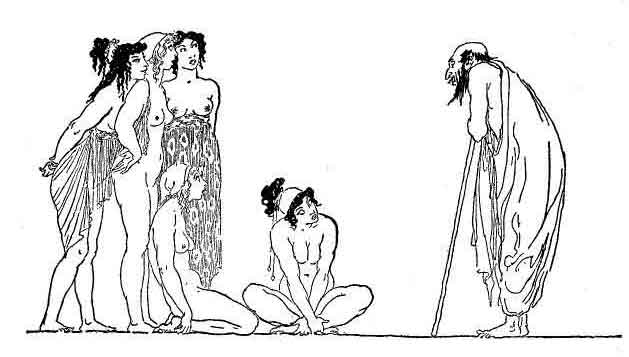
description

Illustration by Norman Lindsay


View all my reviews


Sincerity and AuthenticitySincerity and Authenticity by Lionel Trilling
My rating: 5 of 5 stars

Partial Memories

Few books have influenced my worldview as much as "Sincerity and Authenticity".

If I had to name two others, I would say Karl Marx’ "Economic and Philosophical Manuscripts" ("the Young Marx") and Sigmund Freud’s "Civilization and Its Discontents".

If I had to name a third, I would say Erich Fromm’s "The Art of Loving".

If I had to name a fourth, the only thing that makes me hesitate to mention Herbert Marcuse’s "Eros and Civilisation", is that I can’t remember whether I have actually read it.

Perhaps the pseud in me just pretends that I have read it. Perhaps I just liked the title and that was enough. I could guess the rest.

Partisan Views

All of this reading happened over thirty years ago, when I had just finished an Arts Degree in English Literature and Political Science.

I was determined that I keep my mind alive by continuing my readings in these areas of passion.

I started a lifelong obsession with writers and critics associated with the magazines "Partisan Review" and "Dissent".

Many of them were Jews whose families had come to America from Russia or Eastern Europe in the early twentieth century.

They had a passion for literature and political science, to which I will add philosophy and psychoanalysis.

Not many of them wrote fiction, at least not convincingly, but they nevertheless wrote with style and they appreciated the style of those about whom they wrote (especially Freud and his ability to tell stories).

All these years later, I still derive enormous pleasure from their thinking and writing, and the fact that I think and write at all owes a lot to what I learned from them.

Less Than Total Recall

My two favourite New York Jewish Intellectuals were Lionel Trilling and Irving Howe.

While they both wrote extensively about literature, I would say that Howe was the more overtly philosophical and political.

I am about to commence a personal reading project that involves a more philosophical slant (Kant, Hegel, Marx and the Continental Philosophers up to Zizek).

However, a few days ago, I thought I might indulge in a little preparatory distraction by re-reading Trilling, primarily so that I could enjoy his style and critical authority once more.

The title of the book is so precise and definitive that for me it almost marks this territory as that of Trilling, at least up until 1970, when he presented the lectures upon which the essays were based at Harvard.

If called upon, I could launch into a rant that defined how Sincerity and Authenticity related to my personal philosophy. The subject matter of the book was that fresh in my mind.

Imagine how surprised I was when I discovered how little I recalled of the book (apart from what was implicit in the title)  and how much more it contained that is relevant to my current reading interests.

Suffice it to say, I was exhilarated to read Trilling from a new perspective.

A Moment of Sincerity

The book purports to explore the origin and rise of sincerity and authenticity as subject matter of literature.

It quickly establishes that the process started 400 years ago and that the two concepts rose in parallel in both culture and society.

However, what I had forgotten was just how vital to Trilling’s story were philosophers like Rousseau, Hegel, Marx, Sartre, Marcuse and Foucault, not to mention writers like Diderot, Goethe, Flaubert, Wordsworth, Jane Austen and Joseph Conrad, and psychoanalysts like Freud, Norman O. Brown and R.D. Laing.

This is not just literary criticism, it is fully-fledged cultural criticism of the highest order.

In order to properly engage with it as a discrete work, it helps if you have some comprehension of Hegel.

I am at the beginning of my Hegelian journey, largely initiated by the extent to which he has been newly embraced by European philosophy (although I infer from this book that America made such an attempt in the 50’s and 60’s).

However, insofar as I attempt to grapple with the Hegelian aspects of “Sincerity and Authenticity”, I might misunderstand Hegel and inadvertently or advertently succumb to Trilling’s polemical intent, not to mention my own.

I hope you will pull me up, if I do.

Begin the Beguine

To tell the story of this book, I really ought to define some of the key terms. However, Trilling hasn’t made this task easy for me.

Late in the book, he says, with a hint of patrician bemusement:

"Irony is one of those words, like love, which are best not talked about if they are to retain any force of meaning – other such words are sincerity and authenticity..."

He dances around the words with subtle skill and refinement. He tends to assume we know very well what he is talking about.

The problem now is that both words have become a little old-fashioned or have been co-opted and stripped of meaning by advertising.

Here is the best I can do.

Sincerity

The closest Trilling comes to a definition of "sincerity" is "a congruence between avowal and actual feeling".

If I tell you I feel well or happy or sad, then I actually, really am.

What I say publicly about how I feel privately is true.

There are two aspects of this equation: firstly, I am being honest with myself (or my self); and secondly, I am being honest with you.

As Polonius counselled Laertes in "Hamlet":

"This above all: to thine own self be true
And it doth follow, as the night the day,
Thou canst not then be false to any man."


Conversely, both Shakespeare and Trilling seem to suggest that, if you deceive someone else, you also deceive or betray yourself.

French and English Sincerity

Trilling makes an interesting differentiation between French and English sincerity:

"In French literature sincerity consists in telling the truth about oneself and to others; by truth is meant a recognition of such of one’s own traits or actions as are morally or socially discreditable and, in conventional course, concealed.

"English sincerity does not demand this confrontation of what is base or shameful in oneself. The English ask of the sincere man that he communicate without deceiving or misleading. ..

"Not to know oneself in the French fashion and make public what one knows, but to be oneself, in action, in deeds, what Matthew Arnold called ‘tasks’..."


In other words, the English do not impose a "positive duty" to be full and frank, only a "negative duty" not to deceive.

The French seem to be more concerned about the soul, whereas the English are concerned about the arena of action, enterprise or business. It is still permissible for a sincere man to have secrets.

In both countries, the concept of sincerity became more important as society segmented into discrete public and private spheres, and within these spheres we each became an individual, not just a member of a family, village, crowd or society.

Literature was concerned with "dissimulation, feigning and pretence". Plain speaking was valued.

Authenticity

Trilling supplies less overt guidance with respect to the meaning of "authenticity".

After citing Polonius ("to thine own self be true"), he waxes lyrical:

"What a concord is proposed – between me and my own self: were ever two beings better suited to each other? Who would not wish to be true to his own self? True, which is to say loyal, never wavering in constancy. True, which is to say honest; there are to be no subterfuges in dealing with him. True, which is to say, as carpenters and bricklayers use the word, precisely aligned with him. But it is not easy..."

There follows a discussion of both philosophers and psychoanalysts.

Trilling quotes Schiller:

"Every individual human being…carries within him, potentially and prescriptively, an ideal man, the archetype of a human being, and it is his life’s task to be, through all his changing manifestations in harmony with the unchanging unity of this ideal."

Trilling then asks: is the archetype, the ideal the "own self" to which one should be true?

Whatever the answer, at this early stage, it is apparent that there are already two selves: the actual and the ideal. We have been split in two.

Is one authentic and the other not? Can both be authentic?

It is implicit that authenticity requires one self and a degree of comfort with this self.

The moment you have two or more selves, you have scope for conflict and confusion and inauthenticity.

Trilling then focuses on the implications of multiple selves or inauthenticity.

Hegel

In the second essay, "The Honest Soul and the Disintegrated Consciousness", Trilling uses Hegel as the basis for this discussion.

In the "Phenomenology of Mind", Hegel discusses Diderot’s dialogue "Le Neveu de Rameau" ("Rameau’s Nephew")(which had been translated from the French into German by Goethe).

One aspect of the dialogue highlights how everyone acts a part, performs a role, takes a position, does his dance in order to comply with society’s expectations of them. These "impersonations" are insincere and cause us to lose personal integrity and dignity.

The second aspect is that Diderot suspends judgement on the morality of this loss of integrity. It is not shown to be a negative.

Hegel permits both selves to co-exist, and so posits the "self-estranged spirit" or the "self in self-estrangement".

The one self is an honest soul or noble self, the other a base self. Together, they constitute a "disintegrated consciousness". The self is "alienated" from itself. It becomes "inauthentic".

However, in Trilling’s opinion, Hegel sees the honest soul as more contemptuous. "It is defined and limited by its ‘noble’ relation to the external power of society, to the ethos which that power implies." It is more bourgeois. It needs the base self in order to express a negative relation with the external power of society.

The two selves, together, are both needed for the Spirit to move to the next stage of development. The two selves oppose an integrated selfhood in order to advance towards "a higher level of conscious life".

Thus, both selves, and therefore, their alienation from each other, are required for the development of the Spirit. The dialectic is, by definition, two-fold. The self must be disintegrated in order to eventually become free.

The Sentiment of Being

Trilling resorts to Rousseau to oppose the Hegelian analysis.

Rousseau sees a positive in society that is not present in the "savage":

"The savage lives within himself, the sociable man knows how to live only in the opinion of others, and it is, so to speak, from their judgement alone that he draws the sentiment of his own being."

Still, neither Rousseau not Trilling considers this view a solution to alienation. A conflict between self and society still resides in the individual. It is reflected in the language of David Riesman’s "other-directed" and "inner-directed" personalities.

Plus he argues that culture and art contribute to these behavioural distinctions; they are "agents of conformity".

Jane Austen’s "Mansfield Park"

Trilling had a high regard for Jane Austen.

He sees her as supportive of the "noble" against the "base" self. She implicitly denies the Hegelian dialectic. The goal of nobility can only be achieved by rejection of the base and compliance with the dictates of society.

Trilling acknowledges that this is "not an effort of liberation but an acquiescence in bondage, a cynical commitment to the way of the world, to the metropolitan society which Rousseau had denounced as the enemy of all true being."

However, he says, "when its first unease has been accommodated, it can be seen to have in it a curious power of comfort."

In other words, submission, acceptance, conformity, the "single-mindedness" of knowing one’s place in the world, do away with alienation.

Being and Having

Trilling further discusses the concept of "being" in terms of Wordsworth and Marx:

"...being...is the gratifying experience of the self as an entity."

However, this experience could be compromised by social forces: "the great enemy of being was having."

To quote Marx from the "Economic and Philosophical Manuscripts":

"The less you eat, drink and read books; the less you go to the theatre, the dance hall, the public house; the less you think, love, theorize, sing, paint, fence, etc., the more you save-the greater becomes your treasure which neither moths nor dust will devour-your capital. The less you are, the more you have; the less you express your own life, the greater is your alienated life-the greater is the store of your estranged being."

We might have capital, but we don’t have a life. We are estranged or alienated from our labor and from our selves and other selves. We cease to be humans.

Marx’ goal for communism was to get to the point where we could "assume man to be man, and his relation to the world a human one".

Man had to transcend alienation, and he could only do that through Marx’ self-fulfilling prophecy of Communism.

In a sense, Hegel required alienation to move the Spirit to a higher stage; Marx moved Man to a higher stage by overcoming alienation.

However, Marx’ prescription required a revolution against the bourgeois State.

Freud and Marcuse

In the last essay, "The Authentic Unconscious", Trilling explores the implications of a psychoanalytical understanding of the mind in terms of the Ego, the Id and the Super-Ego.

The conflict between these aspects of the mind are sources of disintegration, alienation and mental illness.

Freud recognised that the Super-Ego was required to regulate the self or the Ego, but that it is unduely harsh and gratuitous in how it goes about its task.

While therapy could attempt to bring aspects of the Id and the Super-Ego within the consciousness of the Ego, Freud did not see any end to the conflict. "We are all ill."

Trilling regards his last work, "Civilisation and Its Discontents" as relatively pessimistic in this regard.

He then investigates Marcuse’s "Eros and Civilisation", an attempt to achieve a harmony between the basic ideas of Marx and Freud.

Marcuse believed that the conflict could be overcome and that, even within the time since Freud’s last book was published, there had been a move towards a more sexually permissive world.

However, ironically, while this illustrated the ability of culture to change, Marcuse was skeptical about whether the particular changes were positive. He actually felt that they were detrimental to some positive aspects of the growth of the individual within a family context.

How Do You Integrate the Self?

It’s at this point that Trilling is most polemical and, therefore, most trapped within the social, moral and political framework of the time in which he was writing.

Rather than pull all of these ideas into a single literary and philosophical whole, he spends the last pages attacking a then current trend of regarding mental illness and schizophrenia as an heroic assertion of the self against the evils of society.

Trilling clearly saw mental illness as a major social and cultural problem.

While he was skeptical of the ability of Marxism or Marcuse to overcome it, he failed to construct any strategy to deal with the disintegration of the self.

He did, however, see culture and literature as a playground and a laboratory within which we could thrash out the issues and potentially learn more about our selves.

Culture might increasingly perform the role of entertainment, but it still has the potential to be both playground and laboratory.

It's up to us to play, experiment and explore.

Perhaps, in doing so, we might address the adverse implications of our own divided consciousness and alienation.

Not only might we improve our relationship with our selves, but our relationships with other selves might benefit.

This is what I want to explore in my personal philosophical reading project.


View all my reviews


Whores for GloriaWhores for Gloria by William T. Vollmann
My rating: 4 of 5 stars

Gloria, Gloria, Gloria

Bill rang me and said do you want to come and meet Jimmy, so I said yes, I’d heard so much about him from Bill, he was going to write a piece, an article or a story about him for some magazine, he was infatuated with some whore, an ex-girlfriend, Gloria, who’d just up and disappeared six months ago, Bill didn’t know whether she was dead or in prison or had gone back to her family to have a baby, Bill had never even met her or seen a photo, all he had to go on was a description from Jimmy, none of the other whores in the ‘Loin remembered her, they’d all arrived since she’d left, once Bill even speculated that she might never have existed, and Jimmy heard about it, and next time he saw him, he punched him in the side of the jaw and loosened a tooth, though they’re good friends now, well good enough to have a drink with and to introduce me to, though as the editor of the novel he was supposed to be writing (I didn't "officially" know about the article) I had to pay of course, not that Bill needed or wanted an editor, he just got me for free, and I had a modest expense account.

We were supposed to meet him at the Black Rose, but he wasn’t there, so we went on a virtual bar crawl, HaRa, Summer Place, Nite Cap, and the Geary Club, nobody had seen him, so I said why don’t we check if he’s at home, it was almost noon and I was ready for a drink, I hadn’t had one since I downed a couple of Bloody Mary’s in the hotel bar for breakfast. We ran into Pearl in the lobby of Jimmy’s building, but she hadn’t seen him yet, so we walked up three flights of stairs until we got to his floor and located room 19, the door was open and the light was on, so we walked in, when this beautiful tall amazonian woman with a great shock of long hair, says, what the fuck are you doing here, we’re looking for Jimmy, we said, well he’s not here, do you know where he is then, no, she said, but if you see him first, tell him I’m looking for him, and if he’s with some whore, he’d better watch his back. Who the fuck are you then, Bill asked, unusually cocky for the writer Bill I knew. Only Jimmy needs to know that, and he’s smart enough to work it out himself. She turned around and continued to unload groceries out of plastic bags into the pantry. Go on, you two can fuck off. She was beautiful, but she had a foul mouth.

We went back to the Black Rose and sure enough, there was Jimmy, sitting at a table, half a Bud in his hand, but it wasn’t his first of the day, he looked like he’d been drinking all day or had started last night and hadn’t stopped. He was talking to a big-breasted whore named Luna, who looked pretty good for her age, behind her sunglasses, we sat with them for five or six rounds, while Jimmy’s head set more and more into his folded arms on the table, all the time calling Luna Gloria, and insisting that she wear a wig he’d brought along in a plastic shopping bag.

To be honest, Bill and I totally forgot to mention the woman in his room, we’d got to talking as soon as we arrived, then some other girls arrived and asked both of us if we wanted to go upstairs, we both said yes, I thought Bill was going to fuck his girl, the younger of the two, but he reckoned afterwards, all he did was talk to her with a recorder going the whole time. My whore, a melancholy one, was an ex-med student who wanted to be a writer, so she was all over me when she found out what I did, she sat me down on the red velvet couch, unbuttoned my shirt and flung it over the side chair, I struggled to get my trousers off, but she stopped me as she crept onto my lap and started to play with my hair, which I hate being messed up, then she ran her hands over my chest, I’m still pretty fit for my age, and she squeezed me, while my grin struggled not to become a grimace, then suddenly, Jesus, fuck, what did you do? I looked down at my left nipple and she had run a six inch safety pin through the soft flesh at its base and closed it before I even knew what was happening. A trickle of blood emerged from the puncture mark at each end, but once the initial shock wore off, it didn’t seem to hurt at all. Still, I wasn’t about to have the other one done. Come on, put your shirt back on and have another drink with me, big boy.

We went back downstairs to our table, from which Jimmy and Luna had departed. I ordered another round of drinks, and the German beer wench asked if I wanted to get a drink for Jimmy and Luna, they were just in the alleyway. I took their drinks out, but the two of them were busily fucking against the wall of the Chinese Restaurant next door.

I put their drinks on the pavement, and returned inside to our table. By this time Bill had come down, we were both thinking it was time to go, he said he wanted to transcribe his tape, I didn’t believe him until later when I saw the transcript of what happened that day. Then there was a commotion at the front door. The woman from Jimmy’s room had arrived and knocked over somebody’s bourbon. The German woman panicked behind the bar, scheiss, Gloria, she said, I thought you were dead. She didn’t bother to return the greeting, she just said, where the fuck is Jimmy, the German hesitated to answer, but her eyes gave her away, they had unknowingly pointed towards the alley, so Gloria went out into the alley and past the Chinese restaurant, not knowing that she would find not just Jimmy, but Jimmy flatbacking Luna on the hood of a car. She wasn’t to know that the whole time he fucked her, he was saying, Gloria, Gloria, Gloria. And that’s just about all I can remember.


View all my reviews


The Lover The Lover by Marguerite Duras
My rating: 4 of 5 stars

Desire

The first time ever I saw your face was on the ferry.

I had my head buried in a copy of the South China Morning Post. My father had said, if I read it every day, I would learn about the world around us, and his boy would become a man. Only then would I be ready to take over the family business after him.

He was right, in his way. I was thin and soft and naïve, even though I had just returned from two years in Paris. I was still a boy, at 28. I’m sure I would have continued as a boy, unless I had met you.

I had slept with many girls in Paris, and I bedded plenty more after you, before I married my wife, a virgin until our wedding night. But I didn't sleep with any of these girls out of love or even desire. I fucked them because I could. They came to me eager to be fucked, and we all knew the reason, my family’s wealth and increasing prominence in Saigon. They all came to me, because they wanted something that my father had.

My father was not an egotistical man. He did not display pride or shame. He did everything out of duty, even make money, buy property, run a department store and build wealth. But when it came to the girls I slept with (not you), and he always found out about them, he took some delight in my sexual activity. No matter how attractive each one was, he knew that by sleeping with them, I was actually disqualifying them from the race to be my wife and share his wealth.  Everyone I slept with narrowed it down to the one I would eventually marry.

I looked up from the Post, some article on inflation, and I saw you taking a seat opposite me. I gazed at you longer than I should have.

Everything about you was wrong. You were Caucasian, white, 15 ½ years old, slim, you were wearing a flowing dress that alternately swayed in the breeze or clung to your body, outlining and highlighting your petite breasts. And you were wearing a man’s fedora and gold shoes.

Once I took all of this in, I tried to resume reading the Post. I was looking down at the page, but I couldn’t distinguish a single word, I was thinking of you and I was shaking. Like a boy.

Later the same week, we happened to be on the same ferry again. I didn’t see you on board, but when my father’s driver (until recently, when he retired, my driver) opened the door to the limousine, I noticed that you were standing near the waterline, apparently deciding what you would do next.

I went up to you, determined to offer you a ride in my car, I mean my father’s car. You were apprehensive at first, but I reassured you of my good faith, and you decided to accept. It helped that I was shaking the whole way through our brief discussion.

While we were talking, we stood side on, so that my driver could see both of us, the sides of our faces and the hints of nervous smiles. Something must have touched him, unless he did it out of a sense of duty to my father, for he took a photo of us that day.

He gave it to me when he retired 10 years ago. I have carried it with me, in my wallet, every day since then. Until today, I haven’t pulled it out and looked at it again. I didn’t need to. That moment, in my eyes, has been engraved in my mind for fifty years. The only difference is that the image confirms that I was there, that it wasn’t all in my imagination, you can see both of us. The image is true, and so now is my memory. Only I’m not sure whether I ever wanted to be reminded.

It’s not that the photo reminds me of a time when I was a boy. After all, it was you who made me a man, not reading the Post.

Like my father before me, I am a man of duty. I have faithfully taken care of my wife, my family, my family’s business. Everything has grown under my watchful and caring eye. I have done the right thing, and I will die a contented man, if contentment is what I am looking for.

No, what that photo and that moment remind me of is my capacity for desire. It is something I eliminated from my field of vision after we parted company, at my parents’ insistence, and you returned to Paris, I thought, with your mother.

I already knew the rudimentary mechanics of sex when we stood before each other, a skinny Chinese boy and a skinny French girl, in my bedroom for the first time. As I had done before, I was shaking. Even my tentative erection looked as if it might shake off and fall to the floor. It’s funny now, but it wasn’t funny then.

Until I met you, I had been lonely. I was even lonelier after I had met you, because of the obsessive love I had for you.

You said, “I’d rather you didn’t love me, but if you do, I’d like you to do as you usually do with women.”

I asked, “Is that what you want?”

You nodded. Still I knew that you would never love me, that you could never love me.

I said, “You’ve come here with me as you might have gone anywhere with anyone.”

You replied, “I can’t say, so far I’ve never gone into a bedroom with anyone.”

You begged me, again, to do what I usually did with the women I brought to my room.

I did my best to comply. Although you were a virgin, I made love to you the way you directed me to. It was different to how I normally did it, well there was one difference, I wept while we made love.

The driver soon learned about you, and so did my father. He could tell I felt differently about you, that I wasn’t disqualifying you, that I wanted to marry this white girl, even though you would never love me in return.

He made his position very clear.

“I will not let my son marry this little white whore from Sadec.”

I tried to obliterate his attitude from my thinking. But it must have affected me subliminally.

In bed, as we fucked more and more passionately, I would call out, “My whore, my slut, you are my only love.” And you and I and my cum and your juices and our sweat would be swept up in a torrent of desire.

For a long time, it seemed as if that torrent would never stop. I didn’t know where the waters sprang from, but I definitely didn’t know where they were heading.

My father did, and so he built a dam that would contain the flow, and one day the torrent just stopped.

Loving you had made me a man, he knew that, as I did, and although we disagreed wildly, I was reconciled to my future in the family business.

As my father loosened his grip on the reins and handed them over to me, I expanded to two and then eventually five department stores, and then years later with such a solid foundation, I started investing in shopping centres in Australia, until my family became the largest private holder of retail real estate in the country.

Like my father, I am not an egotistical man or a proud one. I do this because of duty. But there was a moment when I contented myself with a smile.

I had just signed a contract to purchase a centre in Australia for A$30 million. I signed a cheque for a A$3M deposit and gave it to the Vendor’s lawyer. A youngish fellow, he decided to phone my banker and ask whether I had sufficient funds in my account to clear the cheque. The banker asked what the total sale price was. The lawyer answered, and my banker laughed. “There are enough funds in this account to pay the entire sale price in cash.”

The lawyer turned to me, squeamishly, and declared that we had a deal. I said, “I was under the impression we had a deal before you phoned my bank.”

I enquired after that lawyer once. It turned out he had married one of my property managers and was now running a coffee shop, ironically in one of my centres.

I have two daughters. They run our portfolio, and they do a more professional job of it than either I or my father ever did.

Perhaps, my father was better at taking risks than they are, but to be honest they are pretty good at it. I am proud of them, and he would be too. They have married well, and have given me four beautiful grandchildren.

As I said, I have carried our photo in my wallet for many years, ever since I learned of its existence.

Any other man in my position would possibly say that they had everything that they had ever desired.

For me, that is true, except in one sense that I have tried to overlook for fifty years.

I once desired you, that skinny white French girl in the fedora. I desired you with an intensity that I cannot find words to describe.

I have tried to rationalise and deny that desire. I’ve tried to convince myself that I only ever desired you once. And that is actually the truth. I did only desire you once, but that one occasion has lasted fifty years.

Now that I am about to die, or think I am, and my family will soon gather around me to say their farewells, I must take a match to this photo and set it alight, like you once set me alight, and perhaps, I will never know, perhaps I also set you alight, if not for as long.

My favourite nurse just brought me an ashtray and a cigarette lighter.

It took me two or three attempts to burn this image. It didn’t seem to want to go.

But now it is finished and there are only ashes in the tray, and my failing memory, and when I die and it too goes, there will be nothing left of our desire.


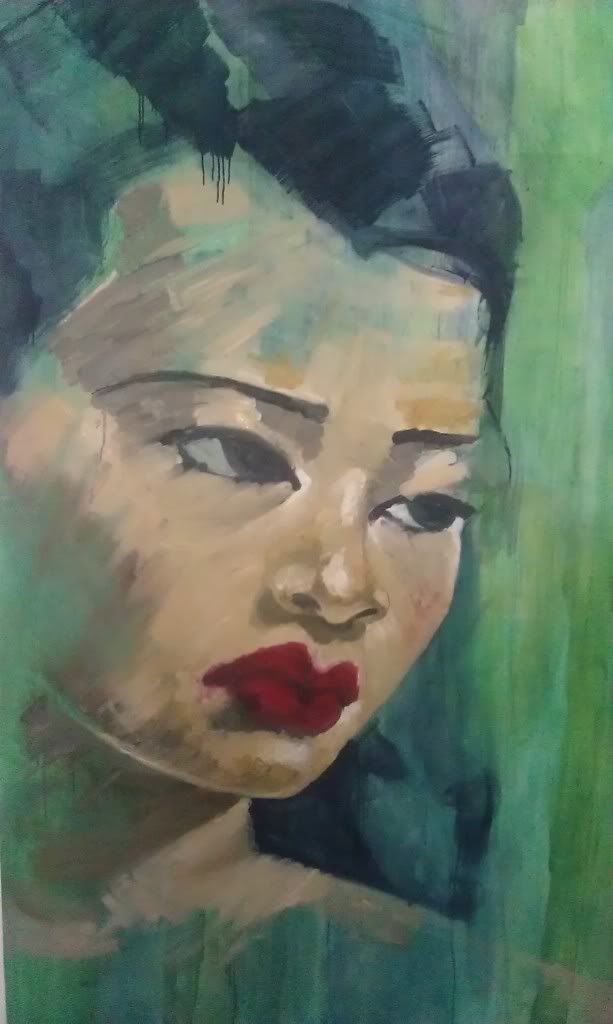
   photo IMAG1670_zps4845f1d3.jpg


Mural at the Pawpaw Cafe attached to the Brisbane Restaurant "Green Papaya"

View all my reviews


Infinite JestInfinite Jest by David Foster Wallace
My rating: 1 of 5 stars

DJ Ian's Sunday Evening "Tell Me What You Really Think"

You're listening to Radio KCRCR, "Tell Me What You Really Think", where we listen to the critics and you talk back. That's if there's any time left after I finish my rant. Hehe.

A lot of listeners ask me about my namesake. What about that other Ian Graye, you say. The one on GoodReads. What do you think of him? And what did you think of his recent review of David Foster Wallace's magnum opus?

Well, let me reassure you: that other Ian Graye is a wanker. Don’t trust his five star review of “Infinite Jest” (“IJ” for short, but not for long).

He is a classic pseudo-intellectual, who occasionally comes under the sway of people like Nathan, MJ and a few female Good Readers with brains and/or ambition, and tries unconvincingly to run with their small herd, while simultaneously feigning the impression of reading, appreciating and reviewing the big books that appeal to them. He is a post-capitalist lapdog of the tamest and most ineffectual kind.

This is what he would say, if he had the guts. Actually, it’s not what he would say, it’s what I'm saying.

He can wallow in pretension.

IJ is a dogs breakfast. Nobody has actually read it from cover to cover. Nobody has understood it on its own terms. Anybody who reckons they’ve read it or understood it is lying and needs to be exposed for the fibbers they are.

The sooner there is something that is post-postmodernism that we can get our hands and minds and kindles and iPatches on the better. No wait, it doesn’t matter.

Postmodernism was invented so that nerds could take money off other nerds.

Meanwhile, the rest of the world can eat, drink, snort, smoke, dance, party and have sex regardless and in spite of the postmodernist nerdfest going down, down, down in the library.

Length

Surely, it is enough to state the length of this book to condemn it.

If an author has 1,100 pages in them, then write four novels of 275 pages each.

Can Sting possibly be any better on the fourth day of his tantric sex than he is on the first?

What is the point? To achieve a target for the Guinness Book of Records? For as soon as you break the record, somebody else will want to beat you and your record will last for, how long, one year, at most?

Repetition

In a book that long, there must surely be a lot of repetition of themes and subject matter, if not dialogue and actual words.

As for a book whose ending simply takes you back to the beginning? That's not what I call recycling. Recycling is the yellow bin. Or, wishful thinking for charities, two copies sitting side by side in a second hand book store.

Self-Indulgence

See my comment about Sting. Beyond that, I risk being guilty of the post-modern crime of repetition. In fact, I might already be guilty. Damn. How ironic.

Irony

Show me somebody who really knows what irony means and I’ll show you a bullshit artist.

I mean, what does “an incongruity between the literal and the implied meaning” mean?

Is there any literal meaning that is not implied? Surely, DFW meant everything his words implied.

Therefore, they are not incongruous, they are deliberate and congruous.

This is starting to sound like that other Ian Graye, so I will stop.

Playfulness

OK, so they play tennis in this book. So what?

And so what if he plays with our minds? Writing this bloody book probably played with DFW’s own mind. How can you control something as gargantuan and prolix as this?

It plays with our minds, because it played with his. If he had won the game, it would have been a shorter, sharper, better book and a more pleasant experience for us.

There is a reason tennis has a tie-breaker. IJ needed a tie-breaker. Around 300 pages.

Black Humor

I like black humor, white humor and Jewish humor. I haven’t heard any other types yet. But I hope I do eventually.

However, I can’t remember any good jokes in IJ, nor can I remember LOL’ing.

Even if I could remember one, there’s no way I would ever tell a mate in a pub or print it on a t-shirt, which is my ultimate test of a good joke, well, an aphorism, anyway.

Intertextuality

I mean, are you serious? Who would invent a word like “intertextuality”, but a postmodernist wanker?

Did the English language really need this word? Did it have to be imported from France or Italy, or wherever?

Intertextuality…”the relationship between one text (a novel for example) and another or one text within the interwoven fabric of literary history…an indication of postmodernism’s lack of originality and reliance on clichés”.

Put two things next to each other, juxtapose them, as the other Ian Graye would say, and you have a relationship (a “juxtaposition”). So what?

If you want to refer to another book in your book, it’s a quote if it’s acknowledged or plagiarism if it’s not.

So what? Any graduate student can do this. We used to call it cheating.

As for cliches, we were taught to eschew them in my day. DFW uses truckloads of cliches, mostly old ones, but many new ones of his own creation. How pathetic. There are nearly as many cliches in IJ as there are in Hamlet. I mean, "To be, or not to be", if Shakespeare was half the writer he's supposed to be (or not to be), he would have steered clear of that old chestnut.

Pastiche

Once again, write your own bloody book.  Don’t copy somebody else’s. Sampling is cheating.  If I want to read the other book or listen to the other song, I’ll find it on iTunes.

Metafiction

Another word created by postmodernists for postmodernists. It’s like a secret handshake. A club for us and not for you. Because you won’t let us into your club, and your club is blockbuster, best-selling fiction with a home and a boat in the Bahamas.

Anybody who can write should strive for a home and a boat, better still, a houseboat. If you haven’t got it in you, don’t waste trees or cyberspace. Write a blog. Do your pathetic little reviews on GoodReads. Or pathetically long reviews, in the case of my namesake.

Fabulation

I mean, honest, we’re talking fiction here, and some critic has to introduce a synonym and pretend it means something different. A distinction without a difference. A high distinction without a job prospect. This is today’s academia for you.

Poioumena

This word makes me want to vomit.

I mean I love Maoris and their language, but words weren’t meant to consist of four consecutive vowels. It's inconsonant.

Historiographic Metafiction

Another one. What, aren’t the old words good enough for postmodernists? This would have been edited out of the wiki article if anybody knew what it meant or had the guts.

Instead, it’s left in, and college students in my wake will struggle to apply it correctly in a sentence for another 20 years.

If this term was a dog, it would be put down. In fact, this term is a dog. Bang.

Temporal Distortion

It gets worse. “Fragmentation and non-linear narratives”. In a word, drugs. Nobody used this language when the poison of choice was alcohol.

In the old days, the bell would ring, and you’d say, “Oh, is that the time?” Not temporal distortion.

Magic Realism

All the best drugs come from South America. Say no more. But put a frat boy in a broad brimmed hat and sit him on a horse and it doesn’t make him a gaucho or a magic realist.

Technoculture and Hyperreality

Doof doof. I can’t remember one computer in IJ. Unless you count microwaves and whatever they played the cartridges on. And, I mean, who remembers cartridges?

Paranoia

The only source of paranoia for me in IJ is the sense that DFW might have known what he was talking about and I didn’t get it. But if he did and I didn’t, then I’ve read all the other IJ reviews on Good Reads, and no two of them are the same, so quit the bullshit and admit it, nobody gets it. It’s time we fessed up, it can’t be got, we weren’t supposed to get it, DFW didn’t design it to be got, leave it alone.

IJ is a conspiracy by the paper manufacturing industry to consume paper, put it inside a hard cover and never let it see the light of day.

Yes, a paranoid conspiracy, I know, but guess what, it worked.

Maximalism

A big word for “long”.

Minimalism

A big word for a little idea. Incongruous, if not ironic, I know.

Encyclopaedic

Yes, IJ is long, but credit where credit is due, it contains a lot of words and meanings, about a lot of things, but let's face it, nobody ever reads an encyclopaedia from beginning to end, we all dip in one entry at a time, if not randomly, and we wouldn’t know shit about all the other bits that we didn’t read.

Let’s hope there's not a question about them in the exam.

Well, that's about it from me. Let me leave you with one more serious thought.

Party at my place. Come on.

KCRCR. Whatever will be will be. And whatever will not be will not be. That is the answer and there's the rub. Thanks, Bill. Can I have my bottle back now, please?

Oh, is that the time? Let's cross to Rupert for the news.


TAME AND INEFFECTUAL POST-CAPITALIST LAPDOG FIVE STAR REVIEW

http://www.goodreads.com/review/show/...


NERDS ONLY PSEUDO-INTELLECTUAL FIVE STAR REVIEW

http://www.goodreads.com/story/show/2...


THE "TELL ME WHAT YOU REALLY THINK" VOTE COUNT (AUDITED BY CHARTERED ACCOUNTANTS NICE WATERCLOSET)

DJ Ian:

February 17, 2013

41 likes

Post-Capitalist Lapdog Review

February 17, 2013

38 likes

Nerd's Only Pseudo-Intellectual Review

February 17, 2013

27 likes

DJ Ian's one star review jennifer garnered more "likes" in 12 hours than either of the other five star reviews did in 10 months (they were posted in April 2012).


View all my reviews


Tonguing the ZeitgeistTonguing the Zeitgeist by Lance Olsen
My rating: 3 of 5 stars

Write Moves

I thought this might have been an ideal introduction to Lance Olsen's fiction before embarking on his longer and more ambitious works.

It's a short, three minute rock 'n' roll novel set in the near future, and I love both rock music and the future. I want to be around for both.

Having finished it, I am a bit ambivalent about reading later novels, unless I can be satisfied that he has addressed some of the flaws in "Tonguing the Zeitgeist".

Beautiful Mutants

This was his second novel, so you can't blame the flaws on the inexperience of a first effort.

Olsen has all the writing chops any author could want, he writes with vitality, his descriptions are vivid, the atmosphere is alive, it's just that the characters are two dimensional, perhaps a little too cybernetic, not human enough.

How can this possibly happen, if your ensemble has embraced androgyny, auto-disfigurement, cacophony, buggerdom, anarchic rebellion, schizophrenia, cruelty, electronic pharmaceuticals and anti-corporate sentiments?

For all the pyrotechnics, the novel is just too emotionally static. It's as if the only thing that moves in the narrative is our eyes, our minds, as we come to some understanding, on our own, of what we have just witnessed.

Everything, everybody is paraded or wheeled out in front of us, until finally we have an ah ha moment, when it all comes together, but with too little impact.

The overall impression is "Is that all there is? Please, sir, can I have some more?"

The Faustian Compact

I could let Olsen off the hook, on the basis that this is his point: that we live in an era of manufactured entertainment, stardom and fame:

"You," Lazar said. "You see, rock music is, well, all rocked out."

"But de idea of fads, mon, dey live forever."


So the machine, in pursuit of the next big thing, sucks meaning and vitality out of artist and audience alike.

Viva Rock 'n' Roll Suicide

For all its pessimism, this message might actually be correct.

If so, no character in "Tonguing the Zeitgeist" rebels or fights it, at least not successfully. We are almost complicit in our own fate.

There are no more old-fashioned heroes any more, only latter day idols and icons.

There is a fatalism at work here, we are all being pulled down the slippery slide or sucked into the quicksand of a dehumanised William Gibson-type future. And then we die, and the gravy train moves on without us.

However, I didn't come here to experience the Wallacian "Entertainment" of "Infinite Jest", as vibrant and alluring as it might be. I want to escape from the experience.

No Zeitgeist Insight

I found it interesting that everybody tries hard, perhaps too hard, to "tongue the Zeitgeist".

Initially, my concern was that the novel was all foreplay and no fornication. It's a hopped up, sexed up, biotech world, the future, according to Olsen.

For some reason, I inferred the aim might have been to fuck the Zeitgeist, not just tongue it. Then I realised it's the characters, we, who have been fucked...by the Zeitgeist.

So this is why Olsen might have stopped at "tonguing". We didn't get to second base when we had bat in hand.

Hysterically Blue-Tongued

This plight reminded me of my childhood, in a metaphorical way.

Have you ever sucked on a nice ice block and you realised that you're tongue has stuck like glue to the ice?  Suddenly, you run urgently to a tap, so you can get some water to part tongue and ice. Everybody else thinks it's hilarious, but the pleasure of the experience is vastly diminished for you.

It's ironic, perhaps, that this is exactly how I reacted to the novel.

For all the pain, though, I just couldn't hold my tongue. I had to tell someone. You.


View all my reviews


Christie Malry's Own Double EntryChristie Malry's Own Double Entry by B.S. Johnson
My rating: 5 of 5 stars

A Novel Epigram

The author, B.S. Johnson:

"The novel should now try simply to be Funny, Brutalist, and Short."

"It does not seem to me possible to take this novel much further. I’m sorry."

Ain’t that the truth.

The Zany Prankster

This novel is Funny, Brutalist, and Short. (Only a little longer than this review actually.)

It takes a simple person, an industrious pilgrim, Christie Malry, and it tells you the truth about him, his place in the world and his progress through it.

Unlike most people, he doesn't necessarily like what he sees, so he does something about it, albeit with his author’s hands or the hands his author supplied him.

He is a prankster, a hoaxster, a subversive, a revolutionary, an urban guerilla, who despises the pious mouthings and hypocrisy of society and religion.

He establishes a personal ledger, containing debits and credits, representing injustices and offences (balanced by appropriate compensation), so he can call society and religion to account.

Notwithstanding the advice of his mother (a sceptic, if not an agnostic or atheist), the expectation is that the ledger will be consulted on the day of reckoning, and justice will be done. Though in the meantime, just in case, Christie does his own reconciliation or reckoning, and takes justice into his own author-supplied hands.

In a way, the novel becomes a piece of metafiction that enables the author, via his character, to rage against the machine.

However, for all the Biblical and Accounting framework, the novel is one of the most humorous and affectionate novels I have ever read.

It is the product of a genius, a metaphorical bomb-maker with a deceptively simple, but explosive message that baffles and mucks about with the establishment, while amusing us zany hipsters.

It is a tragedy that the author did not live to see its publication or to add to his legacy.

It is our duty to ensure that people who care learn of its existence, read it, laugh, love and think.

A Weighty and Inelegant Piece of Dialectic

This is what Christie’s mother has to say about the day of reckoning:

"We fondly believe that there is going to be a reckoning, a day upon which all injustices are evened out...but we are wrong…we shall die untidily…in a mess, most things unresolved, unreckoned, reflecting that it is all chaos.

"Even if we understand that all is chaos, the understanding itself represents a denial of chaos, and must therefore be an illusion."


To the extent that this is a caution against tolerating injustice in the hope of heavenly justice and redemption, it is the equivalent of the existentialist messages (for they are different) of Camus and Sartre, only it’s delivered in an almost offhand, wry, humorous way.

Love

Sexual love sustains Christie during his pilgrimage.

He started life as an idealistic boy who was very fond of his cat and was not afraid to tell his mother:

"I do love pussy."

At age 28, he meets the love of his life, and the two of them are perfectly happy (“well, this is fiction, is it not?")

Guys, has anyone ever said this to you:

"I don’t know why I love you so much…but I do, mystery man."

Has your girlfriend ever said to her mother in front of you:

"We must go now, Old Mum, Sunday’s the only day we have for a really long fuck."

And is this not true love:

"The Shrike loved Christie. Then Christie loved the Shrike. Then they both loved each other, on the carpet in front of her gas fire."


Good Name for a Band

DOOM DOOM and the Sugarboilers


Words I Hadn’t Encountered Before

Aleatoric
Brachyureate
Campaniform
Cryptorchid
Eirenicon
Exeleutherostomise
Fastigium
Helminthoid
Incunabula
Macaronic
Malicho
Nacreous
Retripotent
Sphacelated
Sufflamination
Trituration
Ungraith
Vermiferous
Vermifuge


Upon the Etymology of "Christie Malry"

DJ Ian:

Christie, I’d like to ask you about your names. First name: Christie, surname: Malry.

Christie Malry:

My parents gave them to me.

DJ Ian:

Your parents?

Christie Malry:

Yes, both of them, separately. Well, B.S. Johnson really. The author. He gave my first name to my mother, and she gave it to me. He gave my surname to my father, and he gave it to me.

DJ Ian:

OK, I was really thinking about the metaphorical significance of your first and last names.

Christie Malry:

What could be more significant than that they are my names?

DJ Ian:

Well, Christie might be derived from "Christ". And "Malry" might be derived from "mal", the French word for evil or bad or wrong. So your name might literally represent a war between good and evil? A heavenly dialectic between God and Devilry? Outside the institution of the Church. Diabolical as it might sound.

Christie Malry:

Don’t be ridiculous.

DJ Ian:

I don’t know why my producer exhumed you.

Christie Malry:

I am the body. I am the resurrection.

DJ Ian:

What?

Christie Malry:

I overcome evil with good.

DJ Ian:

Don’t be ridiculous. You’re mucking us about.

Christie Malry:

Is this interview finished? Can I go back to being dead now?


SOUNDTRACK

Stone Roses - "I am the Resurrection"

http://www.youtube.com/watch?v=qyrrTK...

REM - "So. Central Rain" (1st TV performance on 10-06-83)(from the album "Reckoning")

http://www.youtube.com/watch?v=HGiNVZ...


My Father

This novel reminded me of my father.

B.S. Johnson was born on 5 February, 1933, the same year as my father was born.

My father was an accountant in a bank. He wasn’t happy unless the ledgers balanced at the end of the day. A penny out was not good enough. Everybody stayed behind, until debit and credit matched. Only then could he go to the pub.

My father had a sense of humour, which I inherited. So did one of my brothers.

My father died when he was 55 and I was 30, 15 years after B.S. Johnson, so he didn’t get to laugh at all of my jokes. Only the early funny ones. Both of them.

Thanks, Dad. I did enjoy making you laugh for a few short years.


View all my reviews